In this guide
If the top of your roof looks like someone dragged a dirty paintbrush down it, you’re in good company. Dark streaks are one of the most common roof questions we hear from Treasure Coast homeowners, and the usual cause is less alarming than it looks.
Black or dark brown streaks on a Florida roof are usually algae, not dirt or soot. Roofing industry sources describe it mainly as an appearance problem on asphalt shingles. It can be lightened with a gentle, low-pressure cleaning that suits the roofing material. High-pressure washing is the wrong tool, and stains that show up alongside cracked, curled or missing roofing should be checked by a roofer first.
| Roof type | What usually causes dark streaks | What the guidance says about cleaning |
|---|---|---|
| Asphalt shingle | Airborne algae that settles and grows on the surface | A household bleach and water solution applied gently, then a gentle rinse. No power washer, brush or broom. |
| Concrete tile | Algae, mold and mildew | Low pressure and diluted, concrete-compatible cleaners. One tile manufacturer caps water pressure at 1,200 psi. |
| Clay tile | Organic growth on the surface | Glazed or matte ceramic clay tile is described as essentially maintenance-free. Inspect first, and keep foot traffic to a minimum. |
Section 01What Are the Black Streaks on My Roof?
In most cases, those dark streaks are colonies of algae growing on the roof surface. The Asphalt Roofing Manufacturers Association (ARMA) explains that algae spores are carried through the air, settle on roofs and grow there. Both ARMA and Owens Corning name a cyanobacterium called Gloeocapsa magma, often described as blue-green algae, as the most common culprit behind dark roof discoloration.
Is it hurting the roof? On asphalt shingles, Owens Corning says it has not seen evidence that algae deposits affect shingle performance, and describes the problem as mostly aesthetic. On tile, a concrete tile manufacturer, Eagle Roofing, says algae, mold and mildew are not harmful to the integrity of the tile.
That is reassuring, but it doesn’t mean every dark mark on a roof is harmless algae. The other possibilities are covered in section 4.
Section 02Why Are Black Roof Streaks So Common in Florida?
Florida gives roof algae nearly everything it likes. Heat, humidity and a long rainy season help organic growth spread, and shade from overhanging trees keeps parts of a roof damp longer.
That is why one side of a house can look noticeably darker than the other. On the Treasure Coast it’s common to see a bright, sunny slope and a streaked, shaded slope on the same roof.
Section 03How Discoloration Differs by Roof Material
Most published roof-algae guidance is written for asphalt shingles. Florida neighborhoods also have plenty of concrete and clay tile, and those materials aren’t maintained the same way. Advice for one roof type shouldn’t automatically be applied to another.
Asphalt shingles
Algae shows up as dark brown or black streaks. ARMA’s guidance is a household bleach (sodium hypochlorite) and water solution, applied gently and rinsed gently.
ARMA says mixing directions vary by shingle manufacturer, and that other chemicals or methods shouldn’t be used without that manufacturer’s approval.
Concrete tile
Concrete tile can collect algae, mold and mildew, especially on shaded slopes. Eagle Roofing says water pressure should never exceed 1,200 psi and that any cleaner should be diluted and compatible with concrete.
The Tile Roofing Industry Alliance calls concrete tile very low maintenance, with professional low-intensity washing as an option.
Clay tile
The Tile Roofing Industry Alliance describes clay tile with a matte or glazed ceramic finish as essentially maintenance-free.
Clay and concrete tile can both break under foot traffic, so walking on a tile roof should be kept to a minimum.
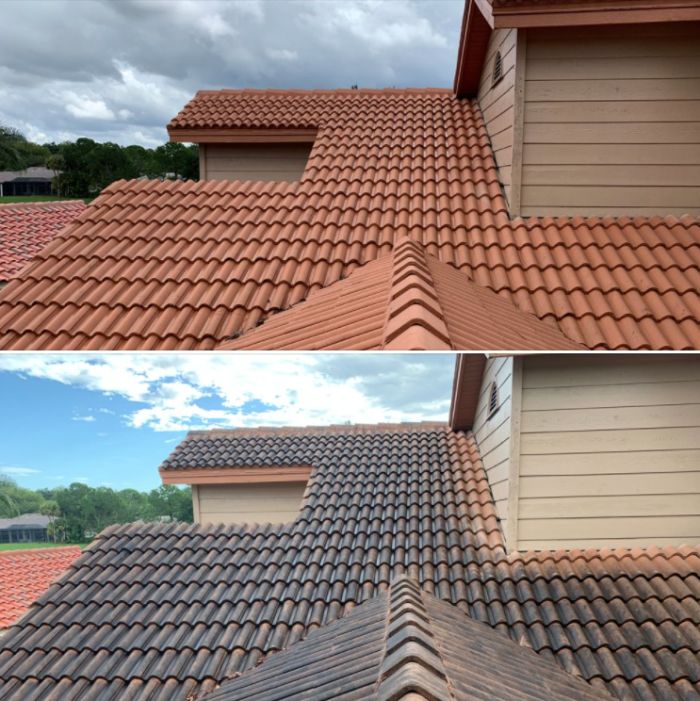
Metal, flat and low-slope roofs have their own considerations too. AquaFlow cleans concrete tile, clay and barrel tile, asphalt shingle, metal, flat and low-slope roofs, subject to an inspection, safe access and the roof’s suitability for cleaning.
Section 04What Else Could Those Dark Stains Be?
Algae is the most common explanation, but it isn’t the only one. ARMA lists fungus, soot, dirt, moss and tree droppings as things that can be mistaken for algae discoloration, and notes that moss and tree droppings usually leave localized marks rather than long streaks.
- Moss. Raised, green growth, usually in patches. Owens Corning notes that its algae-resistant shingles are not designed to address moss or green algae.
- Debris and tree droppings. Spots concentrated under branches rather than streaks running down the slope.
- Soot or general dirt. Easy to confuse with algae from the ground.
- Worn or damaged roofing. ARMA lists excessive loss of the protective mineral granules and cracked, curled or missing shingles among the signs that a roof may need replacing. Cleaning doesn’t fix those.
- White or chalky deposits on concrete tile. That is usually efflorescence rather than algae. The Tile Roofing Industry Alliance says it doesn’t damage the tile and usually goes away on its own.
AquaFlow declines roofs that are damaged. A roofing problem needs a roofer, not a cleaning.
Section 05How Are Black Roof Streaks Cleaned Properly?
Owens Corning’s guidance is similar: a diluted bleach solution, a limited dwell time, a thorough rinse, and no scrubbing or high-pressure equipment. Product instructions vary, so the right mix and method for a particular roof should follow that roof’s manufacturer.
For concrete tile, tile manufacturers set the pressure limits. Eagle Roofing, for example, caps water pressure at 1,200 psi and calls for diluted, concrete-compatible cleaners only.
How AquaFlow approaches roof cleaning
AquaFlow practice
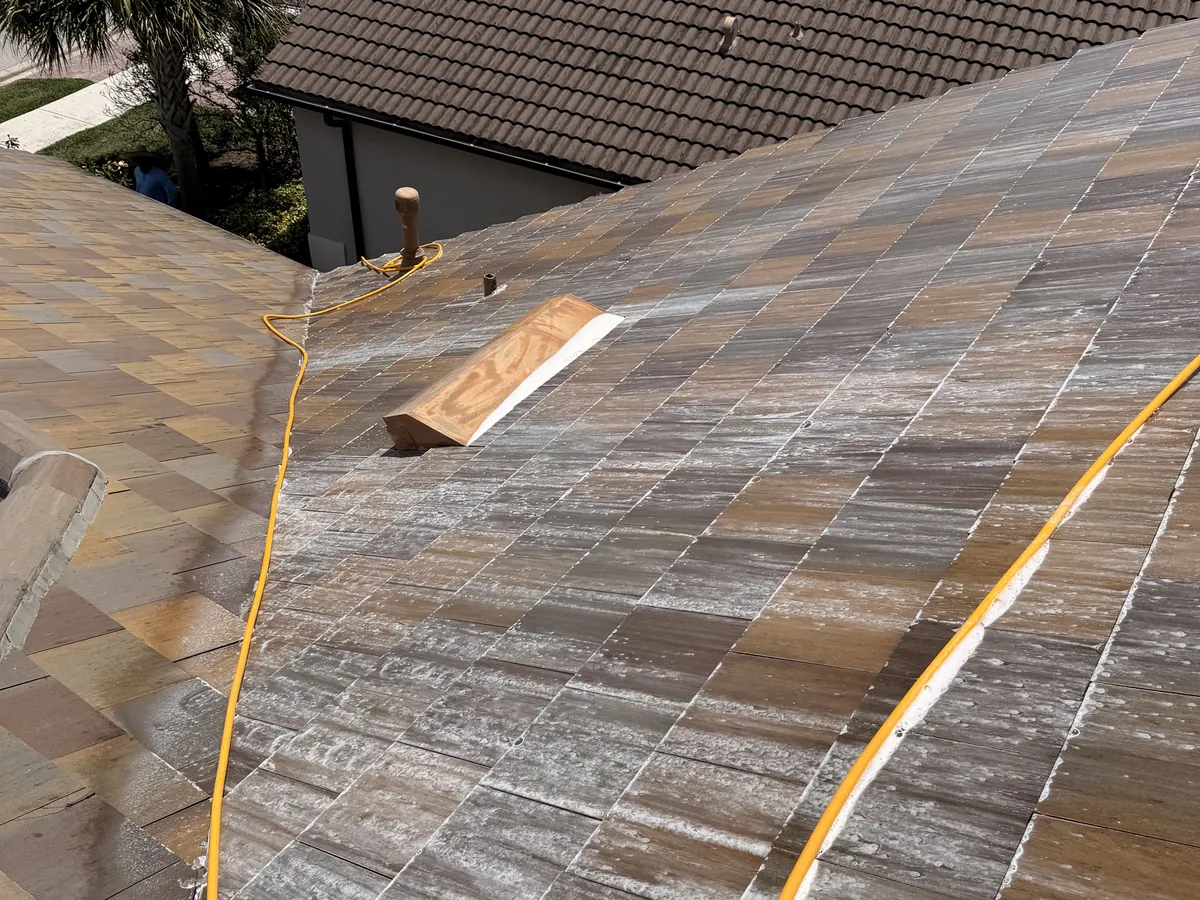
Not every roofing material is cleaned the same way. Before we clean a roof, we inspect it, and that inspection determines the cleaning solution and its concentration. Our roof cleaning is low pressure. We don’t blast roofs with high pressure.
Roofs are rinsed after cleaning. Some remaining discoloration may continue to fade naturally after the visit, and a second pass or post-treatment may be used when appropriate.
AquaFlow Property Protection Protocol
- Inspect: We look over the property first and note existing conditions, with photos when appropriate.
- Protect: We protect what’s around the work area as the job requires, such as sensitive fixtures or landscaping.
- Apply: We use the cleaning method and solution suited to the surface, with proper dwell time where needed.
- Rinse: Cleaned surfaces and the surrounding area are thoroughly rinsed or wiped down, as the service requires.
- Final Check: We inspect our work and take care of anything that needs more attention.
Standard roof cleaning includes the accessible roof sections, the garage roof, exterior gutter rinsing and final cleanup. Gutter brightening, which addresses the dark stripes on the outside face of gutters, is a separate service.
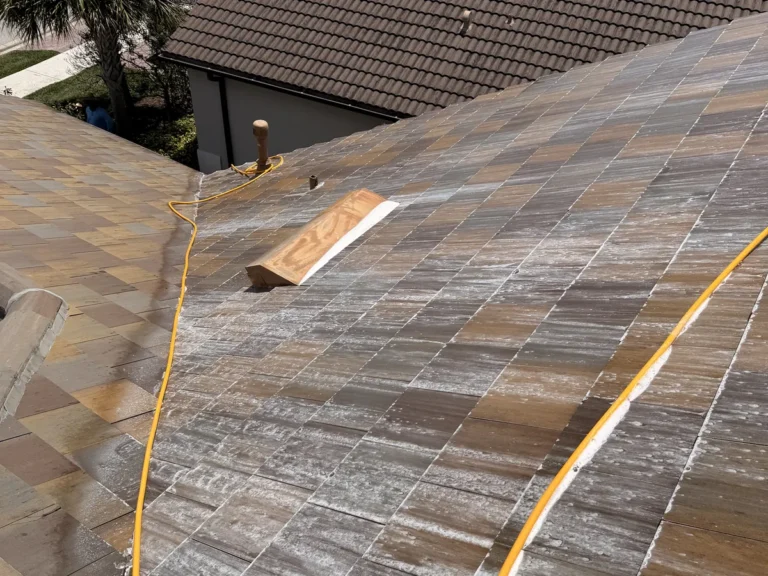 Related serviceRoof Cleaning on the Treasure Coast
Section 06Why Pressure Washing Is the Wrong Tool for Most Roofs
It’s tempting to rent a pressure washer and blast the streaks away. Industry guidance says not to. ARMA says not to use a power washer, brush or broom to remove algae from asphalt shingles, and Owens Corning warns that scrubbing or high-pressure washing can loosen and remove the protective granules.
Tile needs care as well. Concrete tile manufacturers set pressure limits, and walking on tile carries a real risk of breakage. The Tile Roofing Industry Alliance cautions that most tile manufacturers don’t cover breakage from foot traffic.
Low pressure, the right solution and a careful rinse do the work. Force isn’t the goal.
Section 07What Homeowners Should Avoid
- Using a pressure washer, stiff brush or broom on shingles.
- Mixing your own chemicals or using products the roof manufacturer hasn’t approved.
- Walking on tile roofs, which can crack tiles.
- Climbing onto a wet roof. ARMA and Owens Corning both warn that the cleaning process makes roofs slippery.
- Letting cleaning solution and runoff reach plants without protecting them first.
- Assuming every dark stain is algae.
Both ARMA and Owens Corning point homeowners toward trained professionals and proper fall protection rather than do-it-yourself roof work.
Section 08Protecting Landscaping During Roof Cleaning
Whatever runs off a roof lands in your gutters, beds and lawn. Owens Corning advises covering the ground vegetation under the roofline before applying a cleaning solution and flushing the greenery with water afterward. ARMA says to apply the solution carefully to avoid harming the surrounding landscape.
AquaFlow practice
On AquaFlow roof jobs, landscaping receives a neutralizing treatment, and we protect what’s around the work area as the job requires.
Section 09How to Keep Black Streaks From Coming Back
Be realistic: streaks can return. ARMA and Owens Corning both describe cleaning results as temporary, and the same Florida conditions that grew the first round of algae are still there after the roof is clean.
- Let in more sun and air. Owens Corning suggests trimming overhanging branches to reduce shade and moisture on the roof.
- Watch the shaded slopes. North-facing and shaded sections are usually where growth shows up first.
- Ask about algae-resistant shingles when it’s time to reroof. ARMA recommends considering them, and Owens Corning says its algae-resistant shingles use copper-lined mineral granules. Those products target the algae behind dark streaks, not moss.
No single schedule fits every roof. How quickly streaks return depends on shade, moisture and the roof itself. A simple approach is to look at your roof from the ground every so often and act when growth starts to show again, rather than waiting until the whole roof has turned dark.
Section 10When Should You Call a Professional?
Roof cleaning combines height, slippery surfaces and cleaning solutions, and the wrong method can damage the roof. Eagle Roofing notes that walking on a roof can be difficult and dangerous, and that professionals use fall protection.
AquaFlow handles HOA-related roof cleaning requests. If you live in Port St. Lucie, our Port St. Lucie roof cleaning page explains how the service works locally. Elsewhere on the Treasure Coast, start with our roof cleaning page. If the walls are showing green growth too, our guide on how often to wash your house in Florida covers the rest of the exterior.
Frequently Asked Questions
Are black streaks on my roof dangerous?
For asphalt shingles, Owens Corning says it hasn’t seen evidence that algae affects shingle performance and treats it mainly as an appearance issue. Eagle Roofing, a concrete tile manufacturer, says algae, mold and mildew aren’t harmful to the integrity of the tile. Stains that come with cracked, curled or missing roofing are a different matter and should be checked by a roofer.
Is the black stuff on my roof mold?
Usually not. Roofing industry sources identify the dark streaks on most roofs as algae, most often Gloeocapsa magma. Mold, mildew, moss, soot and debris can also discolor a roof, which is why an inspection comes before cleaning.
Can I pressure wash my roof?
Not an asphalt shingle roof. ARMA says not to use a power washer, brush or broom on shingles, and Owens Corning warns that high pressure can remove the protective granules. For concrete tile, manufacturers set pressure limits. AquaFlow’s roof cleaning is low pressure.
Will the black streaks come back after cleaning?
They can. ARMA and Owens Corning both describe cleaning results as temporary, and Florida’s heat, humidity and shade don’t go away. Trimming overhanging branches and keeping an eye on shaded slopes can help you catch regrowth early.
Will my roof look perfect right after cleaning?
Roofs are rinsed after cleaning. Some remaining discoloration may continue to fade naturally after the visit, and a second pass or post-treatment may be used when appropriate.
What kinds of roofs does AquaFlow clean?
AquaFlow cleans concrete tile, clay and barrel tile, asphalt shingle, metal, flat and low-slope roofs, subject to an inspection, safe access and the roof’s suitability for cleaning. Damaged roofs are declined.
Will roof cleaning hurt my plants?
Cleaning solutions and runoff can affect plants, which is why landscaping protection matters. On AquaFlow roof jobs, landscaping receives a neutralizing treatment, and we protect what’s around the work area as the job requires.
My HOA sent a letter about my roof. Can you help?
Yes. AquaFlow handles HOA-related roof cleaning requests. Send us a message or call, and we’ll take a look.
Sources
- Asphalt Roofing Manufacturers Association (ARMA). Algae Discoloration of Roofs. Technical bulletin, June 6, 2024.
- Owens Corning Roofing. Why are there Dark Streaks on My Roof? February 15, 2023.
- Owens Corning Roofing. Cleaning Asphalt Roof Shingles & Other Necessary Roof Maintenance Tips. May 8, 2026.
- Eagle Roofing. How to Properly Clean Your Concrete Tile Roof. March 14, 2019.
- Tile Roofing Industry Alliance. Frequently Asked Questions.
- Tile Roofing Industry Alliance. Technical Briefs: Walkability on Concrete and Clay Tile Roofs (2014).
- Asphalt Roofing Manufacturers Association (ARMA). Frequently Asked Questions for Professionals. May 8, 2017.
The roof cleaning practices labeled “AquaFlow practice” in this article are AquaFlow’s own. The independent sources above provide general information about roof algae, roofing materials and cleaning guidance. They don’t endorse AquaFlow or establish its methods, and the shingle and tile guidance applies only to the roof types each source covers.
Not sure what’s on your roof?
Send us a message or give us a call. We’ll look at the roof and recommend the right approach for the material.