In this guide
Orange and rusty brown stains are some of the most frustrating marks on a Florida driveway. They show up in arcs where the sprinklers hit, in freckles after the lawn gets fed, and along curbs and walls. And unlike ordinary dirt, they often don’t budge when you blast them with a pressure washer. Here is where they come from and why they need a different approach.
Orange and brown stains on Florida concrete are usually iron. The most common sources are irrigation water from wells that carry dissolved iron, iron-containing fertilizer granules that land on the concrete and get wet, and rusting metal left on the surface. Because the stain is a mineral deposit rather than loose dirt, more pressure usually isn’t the answer. It needs a treatment chosen for rust, and the source needs attention or the stain comes back.
| Likely source | Pattern | What usually helps |
|---|---|---|
| Iron in irrigation water | Fan or arc shapes where sprinklers spray, often also on walls and plants; usually well water | Test the water, address iron at the source, and treat the stain |
| Fertilizer with iron | Scattered small orange dots or freckles after lawn feeding | Sweep granules off hard surfaces; treat or let lighter stains fade |
| Rusting metal | A stain shaped like an object, such as a planter, furniture leg or tool | Move the object and treat the stain |
Section 01What Causes Orange Rust Stains on a Driveway?
Almost all orange staining on concrete comes back to iron. When iron dissolved in water meets air, it oxidizes into the rust-colored compounds you see on the slab. Concrete is porous, so that deposit can settle into the surface instead of sitting loosely on top.
The National Ready Mixed Concrete Association groups this kind of mark with other stains from foreign material that reaches concrete after it is placed, naming irrigation and corrosion products alongside things like oil from vehicles. In other words, it is something that happened to the concrete, not a flaw in the concrete itself.
Section 02Iron in Irrigation Water: The Most Common Florida Cause
If the stains follow the spray pattern of your sprinklers, your irrigation water is the likely source. Properties that irrigate from a private well are the most likely to see it, because Florida groundwater often carries iron.
This is why rust stains tend to keep coming back on irrigated properties. Every watering cycle can deposit a little more iron on the driveway, the walkway, the curb and the lower part of the house.
Clear water doesn’t rule iron out. Penn State Extension notes that iron in deep wells is often dissolved and the water looks clear until exposure to air oxidizes it into a rust-colored form. It also points out that some lab tests can under-report iron depending on how the sample is prepared, so ask the lab how it measures total iron.
Section 03Fertilizer Stains: Orange Dots After Lawn Care
A different pattern, small orange spots or freckles scattered across the edge of the driveway, usually points to fertilizer. Some lawn fertilizers contain iron. When stray granules land on concrete and get wet, the iron can stain the surface around each granule.
One easy fix is timing: sweep or blow granules off the driveway, walkway and curb right after the lawn is fed, before the sprinklers or rain wet them. If a lawn service treats your yard, it is worth asking them to clear hard surfaces before they leave.
Section 04Other Sources of Orange and Brown Staining
- Rusting metal. Metal furniture, planters with metal bases, tools, bikes and anything with a steel part can leave a rust outline where it sits on damp concrete.
- Iron-rich soil and water nearby. UF/IFAS Extension in Escambia County notes that orange stains on curbs can be a sign of high iron in the surrounding soil, and that naturally occurring iron-oxidizing bacteria can produce orange coloring in water.
Not every brown mark is rust. Dark brown or black discoloration in shade is more often organic growth; see why concrete driveways turn black in Florida.
Section 05Why Pressure Washing Alone Usually Won’t Remove Rust
Pressure washing is good at lifting loose material: dirt, debris and much of the organic growth that darkens concrete. Rust staining isn’t loose. It is a mineral deposit that forms as iron oxidizes, and on porous concrete some of it settles into the surface.
Turning the pressure up to chase it is usually a mistake. You can etch the concrete and leave stripes or wand marks while the orange stays put. On a driveway, irrigation and rust staining needs a different treatment, not more pressure.
AquaFlow practice
Irrigation and rust staining is evaluated before we treat it. Light staining can often be handled during a driveway cleaning, while extensive staining takes more work and may add to the price. We’ll tell you that during your estimate, before any extra work is done.
Stronger specialty treatments are checked for compatibility with the surface, tested on a small area where appropriate, applied in a controlled way and rinsed according to the product. Concrete is porous, so complete removal can’t always be promised, and we’ll tell you what to realistically expect before we start.
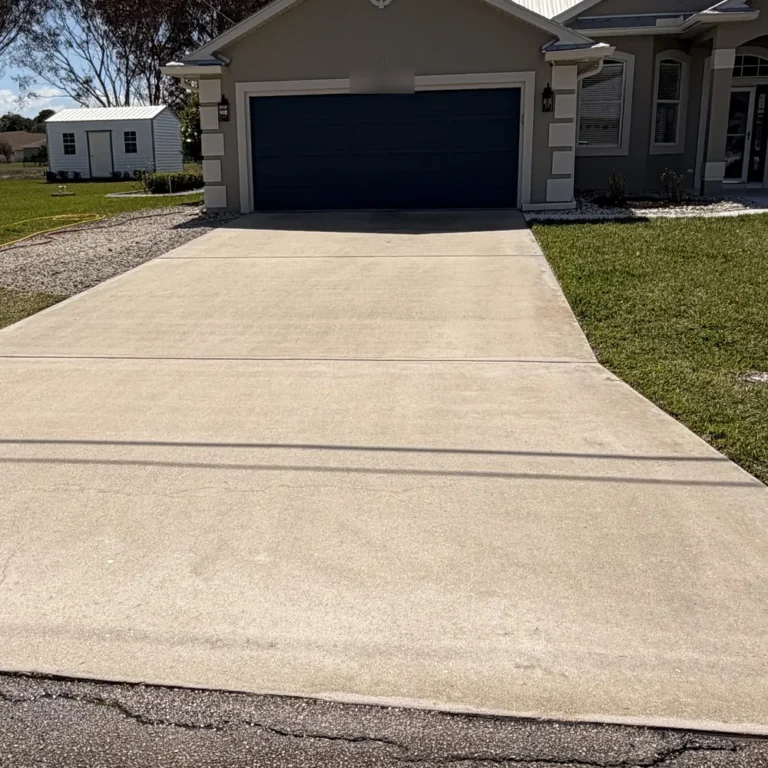 Related serviceDriveway & Concrete Cleaning, Including Rust Stain Treatment
Section 06If You Treat Rust Stains Yourself
Store-bought rust removers are made for this kind of stain, but they are stronger chemistry than a household cleaner. A few precautions go a long way.
- Read and follow the product label, including protective equipment and rinsing directions.
- Test on a small, out-of-the-way area first, especially on colored, stamped, coated or sealed concrete.
- Protect the lawn and plants next to the slab, as the Extension answer above advises.
- Don’t let the product dry on the surface, and rinse thoroughly.
- Expect a stain that has been there for years to lighten rather than vanish.
Section 07How to Stop Rust Stains From Coming Back
Treating the stain without dealing with the source is a short-term fix. If irrigation water is the cause, the driveway will start turning orange again as soon as the sprinklers run.
- Test your irrigation water. UF/IFAS recommends having the water tested first and contacting your county Extension office for direction.
- Treat the water at the source. Once the iron level is known, UF/IFAS’s Florida-Friendly Landscaping program lists options such as water softeners, oxidizing filters and combined chlorination and filtration systems. A water treatment professional can recommend the right one for your well.
- Re-aim sprinkler heads. Keeping spray off the driveway, walkway and walls reduces how much iron reaches them.
- Sweep up fertilizer. Clear stray granules from hard surfaces right after the lawn is fed.
- Move rusting metal. Lift metal furniture and planters off concrete, or set them on protective pads.
Iron staining isn’t limited to concrete. Orange streaks on stucco walls are evaluated separately during a house wash, because rust, widespread irrigation staining and mineral deposits may need different treatment than ordinary buildup. See House Washing.
Section 08When to Call a Professional
It is worth having a professional look at rust staining when:
- The stains cover large areas of the driveway, walkway or sidewalk
- Store-bought products haven’t made a difference
- The concrete is stamped, colored, coated or sealed
- Walls, pavers or pool decks are stained too
- You want the whole driveway cleaned and the rust treated in one visit
AquaFlow treats irrigation and rust staining as part of driveway and concrete cleaning on the Treasure Coast and in northern Palm Beach County, including Port St. Lucie. Pavers are cleaned differently from poured concrete; see Paver Cleaning, Sanding & Sealing.
Frequently Asked Questions
Why does my driveway have orange stains?
Usually iron. The most common Florida sources are irrigation water from wells that carry iron, iron-containing fertilizer granules that get wet on the concrete, and rusting metal objects left on the surface.
Will pressure washing remove rust stains?
Usually not by itself. Rust staining is a mineral deposit, not loose dirt, and turning up the pressure can etch the concrete without removing the orange. It needs a treatment made for rust.
Why do the rust stains keep coming back?
If the stains come from irrigation water, each watering cycle can deposit more iron. Testing the water and addressing iron at the source, along with re-aiming sprinkler heads, is the long-term fix.
How much iron in water causes stains?
UF/IFAS Extension says staining and scaling conditions exist when iron concentrations exceed 0.3 ppm. A water test is the only way to know your level.
Will fertilizer rust stains fade on their own?
An Extension answer on fertilizer stains noted that they tend to fade over time. Sweeping granules off concrete right after application helps prevent new ones.
Can every rust stain be removed?
Not always. Concrete is porous, and older or heavier stains may lighten rather than disappear completely. AquaFlow evaluates the staining first and tells you what to realistically expect before treating it.
Sources
- University of Florida IFAS Extension. Dealing with Iron and Other Micro-Irrigation Plugging Problems (SL 265/SS487). Department of Soil, Water, and Ecosystem Sciences. Reviewed May 2024.
- UF/IFAS Florida-Friendly Landscaping Program. Iron in Water. Florida-Friendly Landscaping in a Minute, September 8, 2020.
- Penn State Extension. Iron in Turfgrass Irrigation Water. Updated June 26, 2024.
- Ask Extension. Iron stains from fertilizer in concrete. Response from Arapahoe County Extension, May 30, 2018.
- UF/IFAS Extension Escambia County. Weekly “What is it?”: Iron bacteria. Updated February 3, 2022.
- National Ready Mixed Concrete Association (NRMCA). CIP 23: Discoloration of Concrete. 2019.
The practices labeled “AquaFlow practice” in this article are AquaFlow’s own. The sources above provide general information about iron in water, fertilizer and staining on concrete. They don’t endorse AquaFlow or establish its methods.
Orange stains on your driveway?
Send a few photos of the staining and where your sprinklers spray. We’ll tell you what we see and what to realistically expect.